Introduction
Every semester, students quietly slip toward failure. They miss a few assignments. They stop logging in. Their engagement drops. And by the time anyone notices, it's already too late to do much about it.
The warning signs were there from week two. AI is finally reading them.
The Problem With How Institutions Respond to Struggling Students
Most universities and schools still operate on a reactive model. A grade drops. A professor sends a flag. An advisor reaches out weeks after the student has already checked out mentally.
This approach doesn't work. About 30% of first-year university students drop out before their sophomore year and the majority show early behavioral signals well before any grade reflects it. The data exists. Institutions just aren't using it in time.
What AI Actually Analyzes
AI early warning systems don't wait for exam results. They read behavioral patterns from the first days of a course:
- Login frequency – how often and when a student accesses their courses.
- Content engagement – whether a student completes readings or opens and closes them in seconds.
- Assignment timing – late submissions in week two predict significantly higher dropout risk.
- Discussion activity – socially disengaged students fail at much higher rates.
- Video completion – a student watching 20% of a lecture is sending a clear signal.
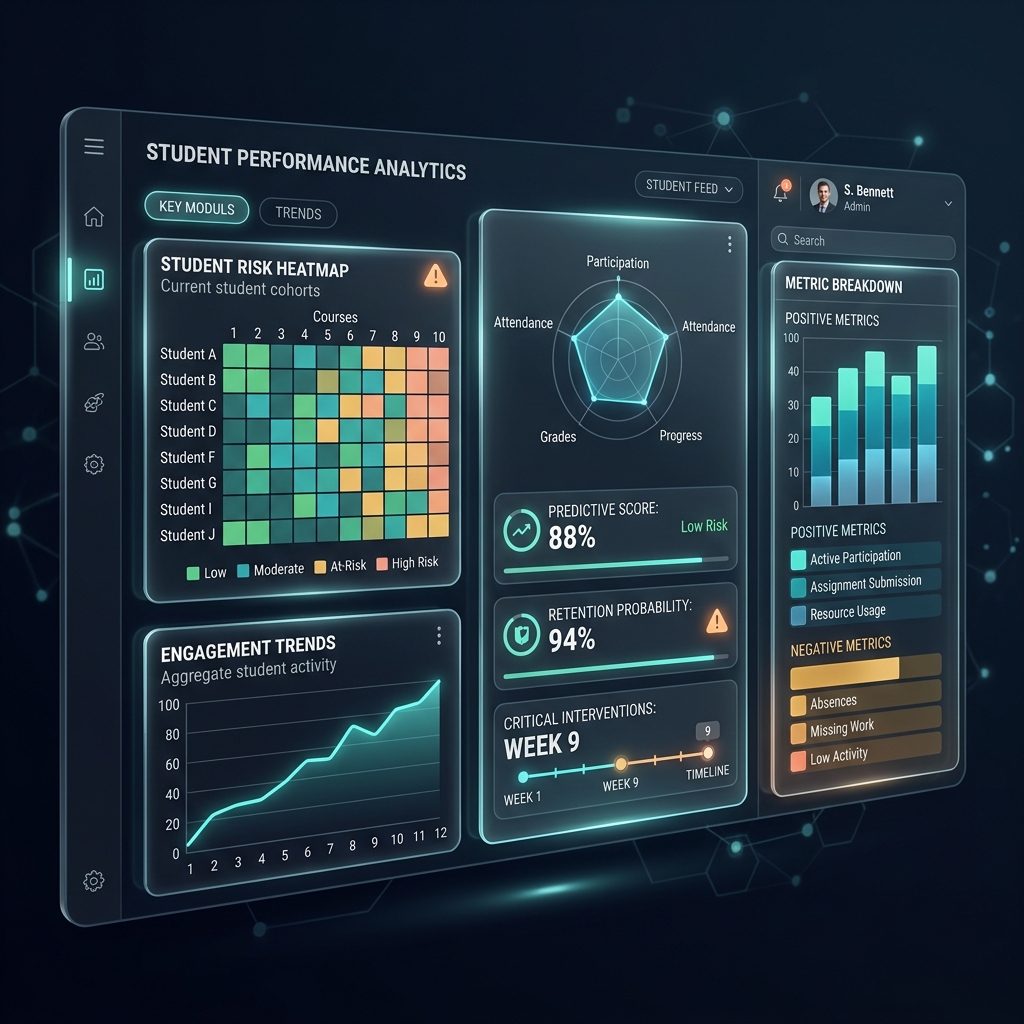
These signals combined allow AI models to generate a risk score for each student, updated weekly before a single grade is entered.
What the Research Says About Accuracy
The numbers are harder to ignore than most institutions expect.
| Metric / Stat | Description | Source |
|---|
| 97% | Recall at week 2 before any grade exists | Kaushal & Mall, arXiv 2025 |
| -30% | Course withdrawal when students receive an early alert | Oregon State University |
| +23% | Graduation rate using predictive advising | Georgia State University (GPS Program) |
A 2025 study published on arXiv found that an LSTM model achieved 97% recall at week two of a course, correctly identifying 97 out of 100 students who would eventually fail or withdraw using mostly demographic and pre-enrollment data.
A separate study out of Oregon State University found that students who received an early academic alert were 30% less likely to withdraw from a course. Georgia State University's GPS advising system, built on predictive analytics, raised graduation rates by 23%.
The technology works. The question is whether institutions choose to deploy it.
The Limits Worth Knowing
AI prediction in education isn't flawless and here are three honest limitations:
- Bias in the model: Systems trained on historical data can flag underrepresented students at disproportionate rates, not because of academic ability but because of systemic inequities baked into past outcomes. Any AI analytics tool needs regular fairness audits.
- Context the model can't see: A student who went silent in week three might be dealing with a family crisis or a mental health episode. The AI flags the absence. A human still needs to find out why.
- It's a radar, not a diagnosis: AI tells educators where to look. What happens next depends on the human systems around it: advisors, professors and support services. A flag that nobody acts on is worth nothing.
What Good Early Warning Actually Looks Like
Not every "analytics" feature in an LMS is built for early intervention. A login history dashboard tells you what already happened. A true early warning system tells you what's about to happen and who needs help right now.
Before adopting any AI analytics tool, institutions should ask:
- Does it generate a risk score or just display activity logs?
- How early in the semester does the prediction become reliable?
- Does the alert trigger a real action or just sit in a tab nobody opens?
- Can it flag a student struggling across multiple courses at once?
The bar is higher than most vendors meet.
Your LMS Already Has the Data. Edora Analytics Makes It Readable.
Edora Analytics was built around exactly those questions. It is a local Moodle plugin that requires zero infrastructure change and gives every stakeholder in your institution the visibility they need to act before a student disappears.
Teachers
Per-student risk score, last login, grade trend, and completion rate. Automated alerts when thresholds are crossed.
Administrators
See how the whole institution is performing across all courses and cohorts in one place.
Students
Grade predictions based on current pace, anonymous peer benchmarking, and an activity heatmap of effort over time.
Advisors
Private communication log and follow-up reminders. Notes shared directly with each student's profile.
No new system to learn. No infrastructure change. Just the data you already have, finally readable.